GAMBIA – Barrow’s third-term push sparks fear of democratic backslide

Special report by Ebrima Sarr
With less than ten months until polling day, The Gambia is entering a tense pre-election period as President Adama Barrow prepares to seek a controversial third term in the December 5, 2026, presidential election.
The Independent Electoral Commission (IEC) has confirmed the date and released the full 2026–2027 electoral calendar. Key milestones include supplementary voter registration from April 1 to May 14, 2026, candidate nominations from October 26 to November 6, 2026, and a campaign window running from November 10 to December 3, 2026. The presidential vote will be followed by National Assembly elections on April 10, 2027, and local polls later that year.
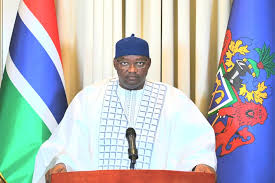
Gambia’s President, Adama Barrow
Barrow, 61, leader of the ruling National People’s Party (NPP), has declared his intention to run again despite his 2016 campaign promise to serve only one term and push for constitutional term limits. That pledge helped rally a coalition that ended Yahya Jammeh’s 22-year authoritarian rule in 2016–2017, with ECOWAS intervention securing a peaceful transition. Barrow won re-election in 2021 with roughly 53% of the vote.
Efforts to enshrine presidential term limits in the constitution failed in both 2020 and 2025, falling short of the required three-quarters majority in the National Assembly, where Barrow’s allies hold significant sway. Critics, including opposition parties and civil society groups, argue that a third term risks reversing democratic gains and reviving executive overreach reminiscent of the Jammeh era.
Public sentiment appears divided. Recent polls, including one by the Centre for Policy, Research and Strategic Studies (CEPRASS), show a majority, around 55–58, opposing Barrow’s bid and viewing a third term as detrimental to democracy. Disapproval is particularly strong among younger voters in a country where 60% of the population is under 25.
The opposition remains splintered across multiple parties, complicating any united challenge. Veteran politician Ousainou Darboe, 77, of the United Democratic Party (UDP), was confirmed as the UDP’s flagbearer following an internal contest. Darboe, a former vice president under Barrow (2018–2019) and longtime opposition stalwart, finished second in 2021 with 28% of the vote.
Younger voices within the UDP pushed for change, leading to the departure of Kanifing Mayor Talib Ahmed Bensouda, 40, who formed the Unite Movement for Change (UMC) and is positioning himself as a fresh alternative focused on youth, urban development, and governance reform. Other declared or potential contenders include Mama Kandeh of the Gambia Democratic Congress (GDC), who took 12% in 2021, and independent figures such as National Assembly member Bakary K. Badjie.
Calls for an opposition coalition continue, with analysts warning that fragmentation could hand Barrow an advantage despite his disapproval ratings. Economic hardships, persistent poverty affecting over half the population, low per-capita income, and high youth emigration, remain central campaign issues, alongside governance concerns such as press freedom improvements offset by reports of journalist intimidation and uneven accountability for past abuses.
The IEC emphasizes transparency and inclusion in its preparations, while civic groups like the National Council for Civic Education promote voter education and peaceful participation through campaigns such as “My Vote, My Future.”
As the campaign season approaches, the 2026 election will test whether The Gambia can consolidate its post-2016 democratic transition or face renewed concerns over power concentration. The outcome could shape the nation’s trajectory for years to come.
Read Also:
506
Comments are closed

Stay Updated!

Subscribe to get the latest blog posts, news, and updates delivered straight to your inbox.

By pressing the Sign up button, you confirm that you have read and are agreeing to our Privacy Policy and Terms of Use

Recent Posts: