A proposed ₦780 million federal government intervention involving 130 churches in Bende Federal Constituency of Abia State has triggered a fresh national debate over constituency projects, public accountability and the use of government funds to support programs implemented through religious organisations.
According to Arise News, the controversy followed reports that approximately ₦1 billion had been provided in the proposed 2026 Federal Budget for the procurement and distribution of musical and cultural equipment to churches in Bende Local Government Area.
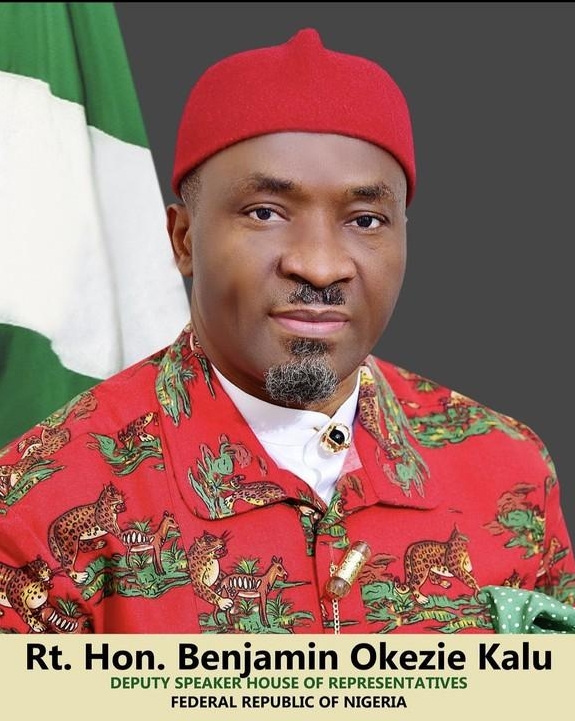
The office of the Deputy Speaker of the House of Representatives, Hon. Benjamin Okezie Kalu, who represents Bende Federal Constituency, subsequently issued a clarification, saying the reports had misrepresented both the amount and the purpose of the intervention.
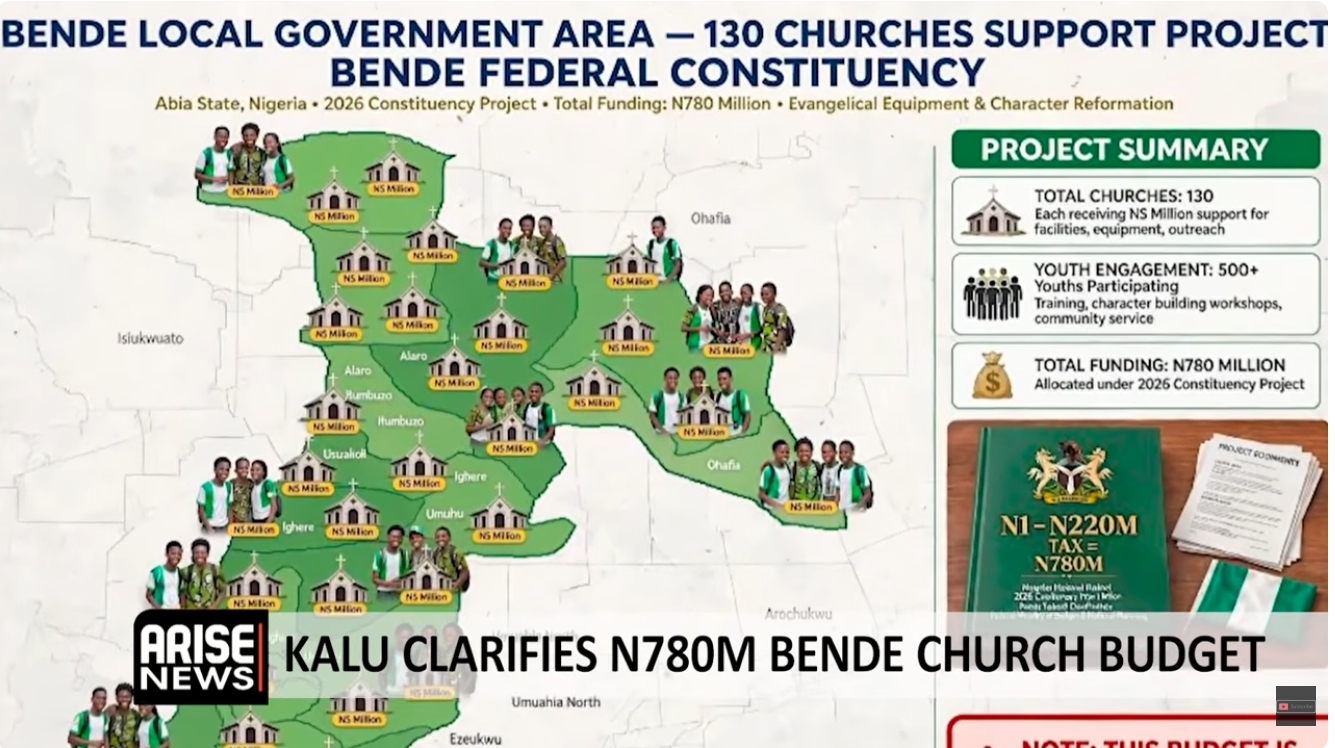
According to a statement issued by Levinus Nwabughiogu, Chief Press Secretary to the Deputy Speaker, the actual provision, after Value Added Tax (VAT) and other statutory deductions, is ₦780 million.
The Deputy Speaker’s office said the money was not intended solely for musical instruments but formed part of a broader Youth Re-orientation and Social Support Programme to be delivered through faith-based organisations across the constituency.
The issue has nevertheless generated questions about how public funds are allocated, how beneficiaries will be selected, what procurement procedures will be followed and how the government intends to measure the programme’s impact.
In its clarification, the office of Benjamin Kalu said Bende Federal Constituency has 13 federal political and electoral wards and more than 200 churches.
The first phase of the program it said, is expected to cover approximately 130 churches, representing an average of about 10 churches per ward.
Each selected church is expected to receive support valued at between ₦5 million and ₦6 million, although the exact form of the support and the procurement arrangements have not yet been publicly detailed.
The programme is reportedly intended to strengthen existing youth engagement platforms operated by faith-based organisations and support community outreach initiatives.
The Deputy Speaker’s office said the intervention would include the provision of evangelical musical instruments and public address systems, which would be used as part of campaigns against drug abuse, sexual offences, violent crime and other social vices.
The programme is also expected to promote discipline, peaceful coexistence, moral values and character development among young people.
Kalu’s office has argued that government investment should not be limited to roads, buildings and other physical infrastructure, but should also include programmes aimed at developing the character and values of citizens.
The intervention, according to the statement, is therefore being presented as part of a broader “non-kinetic” approach to addressing insecurity by using trusted community institutions to engage young people and promote social cohesion.
Benjamin Okezie Kalu, a member of the All Progressives Congress (APC), is the current Deputy Speaker of Nigeria’s House of Representatives and represents Bende Federal Constituency in Abia State.
His official profile on the National Assembly website lists his legislative interests as including national development, women and youth inclusion and empowerment, and project implementation.
Because Kalu is both the federal lawmaker representing the constituency and one of the presiding officers of the House of Representatives, the proposed intervention has attracted particular attention.
The controversy is not simply about the amount involved. It also raises a broader question about the boundaries between constituency development, religious institutions and government-funded social programs.
At present, the official clarification does not publicly identify the names of the 130 churches expected to participate in the first phase.
The statement refers broadly to faith-based organisations across Bende Federal Constituency, saying the program will cover about 130 churches from a constituency with more than 200 churches.
This means that, at the time of publication, it would be premature to state that particular churches are beneficiaries unless their names are confirmed by official procurement documents or the program administrators.
Africa Connect Online understands that the actual list of beneficiary churches has not yet been publicly released.
The absence of a published beneficiary list is likely to become an important part of the accountability debate as implementation progresses.
One of the issues at the centre of the controversy is the difference between the widely reported ₦1 billion figure and the ₦780 million figure subsequently provided by the Deputy Speaker’s office.
Kalu’s office explained that the ₦780 million represents the amount available after VAT and other statutory deductions.
It also maintained that the initial reports had incorrectly portrayed the budget provision as being exclusively for the purchase of musical instruments.
The office said the provision actually forms part of a larger youth re-orientation and social support program.
There was also an indication that a technical error in the procurement description would be corrected through a corrigendum before implementation.
That clarification may settle the question of the government’s stated intention, but it does not necessarily end questions about the allocation itself.
For critics, the key issues remain: Why are churches being used as vehicles for a federally funded program? How will procurement be conducted? Who will select the beneficiary churches? What exactly will each church receive? Who will own the equipment? And how will the public know that the ₦780 million has been properly spent?
The Deputy Speaker’s office has also stressed that the 2026 Federal Budget has not yet been fully implemented and that the government is currently operating under the 2024 and 2025 budgets.
It said no money has yet been released for the programme and that procurement would only begin after the necessary budget releases and approvals.
This distinction is important.
The current controversy therefore concerns a budget provision and proposed intervention, rather than evidence that ₦780 million has already been transferred directly to 130 churches.
Any reporting that suggests the churches have already received the money would, based on the available information, be premature.
Despite the government’s explanation, the proposal has raised concerns among Nigerians who question whether public funds should be channelled through religious organisations.
The debate comes amid longstanding concerns about the transparency of constituency projects and the implementation of government-funded empowerment programs.
Critics argue that programmes involving large numbers of small beneficiaries can be difficult to monitor unless there is a transparent system for:
- Identifying beneficiaries;
- Publishing procurement contracts;
- Disclosing the exact items purchased;
- Establishing the unit cost of each item;
- Conducting competitive procurement;
- Publishing delivery records;
- Auditing the expenditure;
- Measuring the program’s actual impact.
These questions are particularly relevant when the beneficiaries are private religious organisations rather than conventional government institutions.
The issue, therefore, is not necessarily whether churches can contribute to youth development. Many churches already operate youth ministries, counselling programs, rehabilitation initiatives, educational institutions and community outreach programs.
The question is whether a government-funded program involving hundreds of millions of naira can be administered through churches while maintaining the same level of transparency, accountability and public oversight expected of conventional government projects.
Nigeria’s constituency project system has long been the subject of public debate.
Supporters argue that elected representatives need mechanisms to direct development projects to communities that may otherwise be overlooked by federal ministries, departments and agencies.
Critics, however, have repeatedly raised concerns about project selection, implementation, duplication, inflated costs and weak monitoring.
The Bende program has now become part of this larger national discussion.
Critics are likely to ask whether ₦780 million could have produced greater measurable public value if directed toward areas such as primary healthcare, schools, water supply, roads, agricultural support, youth employment or vocational training.
Supporters of the program, on the other hand, would argue that social problems cannot be solved through physical infrastructure alone and that youth development, moral instruction and community-based prevention programs are legitimate components of public policy.
The central question may therefore be less about whether youth re-orientation is necessary and more about how the program is designed, funded, implemented and audited.
The Deputy Speaker’s office has described the programme as part of a non-kinetic approach to tackling insecurity.
The concept of non-kinetic security generally involves addressing the social and economic conditions that contribute to crime and instability rather than relying exclusively on military or law-enforcement responses.
In the context of Bende, the government appears to be arguing that churches can serve as community-based platforms for reaching young people and discouraging drug abuse, violent crime and other social vices.
The logic is that religious organisations already have established networks, regular contact with young people and community influence.
However, critics may reasonably ask how the effectiveness of such a program will be measured.
For example, will the government publish the number of young people reached?
Will there be measurable reductions in drug abuse or youth crime?
Will participating churches be required to submit financial and programme reports?
Will independent auditors verify the purchases?
Will the public be able to see the procurement contracts?
These questions will become increasingly important if the programme moves from budget provision to actual implementation.
The controversy also comes at a time when Nigerians are confronting serious economic pressures, including high living costs, unemployment, insecurity and concerns about access to essential public services.
For many citizens, the idea of allocating hundreds of millions of naira to religious organisations for musical instruments and public address systems may appear difficult to reconcile with the country’s pressing development needs.
Others may argue that youth development programmes are essential precisely because of the social pressures confronting young Nigerians.
The disagreement ultimately reflects two competing approaches to public policy.
One side sees investment in moral education, youth engagement and community-based prevention as a legitimate form of development.
The other sees the allocation as an example of misplaced priorities, particularly if public funds are used for equipment that could be considered the responsibility of private religious institutions.
Regardless of one’s position on the programme, the strongest test will be transparency.
If the Federal Government and the Deputy Speaker’s office proceed with the intervention, several pieces of information could help address public concerns.
These include:
- The complete list of the 130 beneficiary churches.
- The criteria used to select them.
- The name of the government agency responsible for implementation.
- The procurement method and contractors involved.
- The exact items to be supplied to each church.
- The unit cost of musical instruments and public address systems.
- The total value of goods allocated to each beneficiary.
- The ownership status of the equipment.
- The monitoring and evaluation framework.
- Independent audit reports after implementation.
Making such information publicly available would allow Nigerians to judge whether the programme represents genuine youth development or simply another form of constituency patronage.
The ₦780 million Bende intervention has therefore become much bigger than a debate about musical instruments.
At its core, it raises fundamental questions about the relationship between government, religion and public spending in Nigeria.
The government and Deputy Speaker Benjamin Kalu have presented the programme as an investment in young people, moral values and community-based approaches to insecurity.
Critics, however, are likely to continue asking whether such objectives justify the use of hundreds of millions of naira through religious organisations and whether adequate safeguards exist to prevent waste, political patronage or abuse.
For now, the programme remains a proposed 2026 budget intervention, not a completed disbursement.
The next stage, if and when funding is released and procurement begins—will determine whether the initiative can withstand public scrutiny.
For the people of Bende and Nigerians watching from outside the constituency, the most important issue may ultimately be simple: Can the government demonstrate, in clear and verifiable terms, exactly where every naira goes and what measurable benefit it delivers to young people?
That is the standard by which the ₦780 million Bende church-based youth re-orientation programme is likely to be judged.
Africa Connect Online will continue to monitor the programme and report on the release of the beneficiary list, procurement details, implementation and any further clarification from the office of the Deputy Speaker or relevant government agencies.
Editor’s Note: This report distinguishes between confirmed statements from the Deputy Speaker’s office and wider public concerns about accountability. Africa Connect Online has not independently verified the identities of the 130 proposed beneficiary churches, and no specific church has been identified as a beneficiary in the official clarification available at the time of publication.
Sources: Reports and official statements cited above, including the National Assembly profile of Deputy Speaker Benjamin Kalu and statements attributed to his Chief Press Secretary, Levinus Nwabughiogu.