Nigeria court sentences four to death over deadly Owo Church massacre

Segun Olawole reports from Akure
A Nigerian federal court on Wednesday sentenced four men to death for their role in the 2022 terrorist attack on St. Francis Catholic Church in Owo, Ondo State, one of the deadliest assaults on a place of worship in the country’s recent history.
The attackers stormed the church on June 5, 2022, during Pentecost Sunday celebrations, opening fire on worshippers and detonating explosives as congregants attempted to flee. At least 50 people, including children, were killed, while scores of others sustained injuries in the massacre that shocked the nation and drew international condemnation.
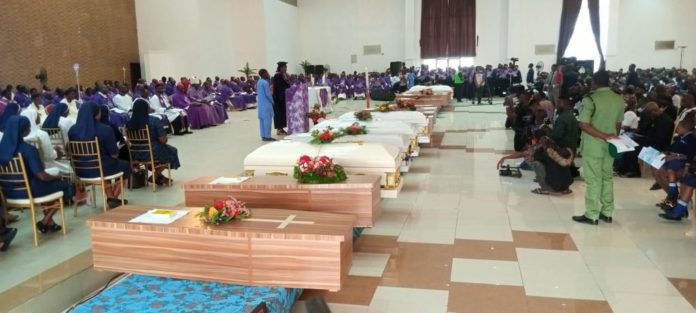
Mass burial service conducted for victims in 2022. Photo courtesy ICIR
The attack occurred in the southwestern town of Owo, far from the epicenter of Nigeria’s long-running Islamist insurgency in the northeast, raising fears at the time that extremist violence was spreading into previously safer regions of the country.
Delivering judgment, the court convicted the four defendants — Idris Abdulmalik Omeiza (25), Al Qasim Idris (20), Jamiu Abdulmalik (26), and Abdulhaleem Idris (25) — and sentenced to death by hanging, while Momoh Otuho Abubakar (47), the fifth defendant, walked free after being cleared of terrorism-related charges.
According to prosecutors, the convicted men were linked to an extremist network operating from neighboring Kogi State in north-central Nigeria, approximately 200 kilometers from Abuja, the nation’s capital. Authorities said the group maintained operational ties with Somalia-based al-Shabab militants, although Nigerian security analysts have long debated the extent of such transnational connections.
The Owo church massacre marked a significant escalation in attacks targeting civilians and religious institutions in southern Nigeria. The assault sparked nationwide outrage, with then-President Muhammadu Buhari describing it as a “heinous and satanic attack.”
Nigeria continues to grapple with multiple security crises across different regions of the country. In the northeast, Boko Haram and its splinter faction, the Islamic State West Africa Province (ISWAP), have waged a violent insurgency for more than a decade, killing tens of thousands of people and displacing millions.
In the northwest and north-central regions, armed gangs commonly referred to as bandits frequently carry out mass kidnappings for ransom, attacks on rural communities, and assaults on highways. Security concerns have also grown over the emergence of newer extremist groups, including the IS-linked Lakurawa network reportedly active near Nigeria’s border with Niger Republic.
The sentencing comes amid a broader push by Nigerian authorities to demonstrate progress in the fight against terrorism. In April this year, Nigerian courts convicted more than 300 terrorism suspects during a large-scale mass trial conducted over four days, underscoring the scale of the country’s ongoing battle against insurgency and violent extremism.
Despite repeated military operations and counterterrorism campaigns, analysts say insecurity remains one of the most pressing challenges facing Africa’s most populous nation.

6542
Comments are closed

Stay Updated!

Subscribe to get the latest blog posts, news, and updates delivered straight to your inbox.

By pressing the Sign up button, you confirm that you have read and are agreeing to our Privacy Policy and Terms of Use